
Sustainable Shipping Solutions
- GREEN STRATEGY
- Sustainable Shipping Solutions
- GOVERNANCE
- OPERATIONAL EXCELLENCE
- SUSTAINABILITY REPORTS
What is ONE LEAF+?
As part of ONE's efforts to decarbonise, ONE LEAF+ is an additional service offered to enable customers to manage their Scope 3 GHG emissions. ONE LEAF+, which stands for Low Emission-Able Freight, is a suite of solutions designed to assist its clientele in reducing the GHG footprint of their cargo. The "+" symbolizes the advancement that ONE anticipates will result from decarbonizing the supply chain.
By deploying low emission alternative fuels on selected vessels, ONE generates CO2e savings for customers who wish to reduce their Scope 3 GHG emissions on their shipments with ONE. CO2e savings (link to certificate) will be allocated to customers using the book-and-claim methodology, which allows customers to purchase the beneficial aspects of the low emission alternative fuel for their entire shipment.
Process flow
| S/N | Process |
|---|---|
| 1 | ONE LEAF+ booking confirmed |
| 2 | Biofuel purchased by ONE and consumed by ONE’s vessels |
| 3 | CO2e savings measured and verified by independent 3rd party verifier |
| 4 | CO2e savings allocated to customer’s shipment and delivered to customer |
FAQ
1. What is the book-and-claim methodology?
2. What is the difference between CO2e and CO2?
Under the Well-to-Wake methodology, ONE will account for the warming effect of all significant global warming gases (for eg CH4, NO2, SO2)
3. What are scope 3 emissions?
Scope 3 emissions refer to indirect emissions arising from a company's value chain. It covers 15 categories upstream and downstream. A company's scope 3 emission is your valuechain supplier scope 1 and 2 emissions.
FAQ on GHG Protocol here.
4. How can I purchase this service?
Please contact your local sales representative to enquire further and purchase this service as it is not directly available on e-commerce at this stage.
5. How is this service priced?
6. What standards are applicable to this service & sample certificate?
ISO 14067:2018 (Greenhouse gases Carbon footprint of products)
2023 Global Logistics Emissions Council Framework for Logistics Emissions Accounting and Reporting V3.0
7. Is ONE LEAF+ available for all container types/trade lanes?
8. How are CO2e savings and emissions avoidance calculated?
To calculate our customer’s existing emissions, ONE employs the industry-standard Clean Cargo Working Group methodology managed by Smart Freight Centre.
Under ONE LEAF+, CO2e savings are calculated by subtracting the well-to-wake CO2e emissions of our use of biofuel under ONE LEAF+ from that of conventional fuel. The CO2e savings, verified by 3rd-party verifier, are allocated to our customers who choose ONE LEAF+ to reduce their estimated emissions.
9. When will I receive my CO2e savings?
10. What kind of biofuel does ONE use?
11. Are there any plans to use other low emission alternative fuels in the future?
Biofuel is the first alternative fuel available under ONE LEAF+. ONE has placed an order for 12 Methanol Dual-Fuelled boxships which will be delivered in 2027 and continues exploring further emission reduction solutions.
Please refer to details of our Green Strategy here.
Sample Certificate
About ONE Eco Calculator & Methodology
At ONE we believe that reaching decarbonisation is not an individual effort but the effort from across the industry. To encourage our customers to measure and manage their cargo emissions, we would like to introduce ONE Eco Calculator. ONE Eco Calculator allows you to calculate the emissions of your container transport from the start to end of the journey.
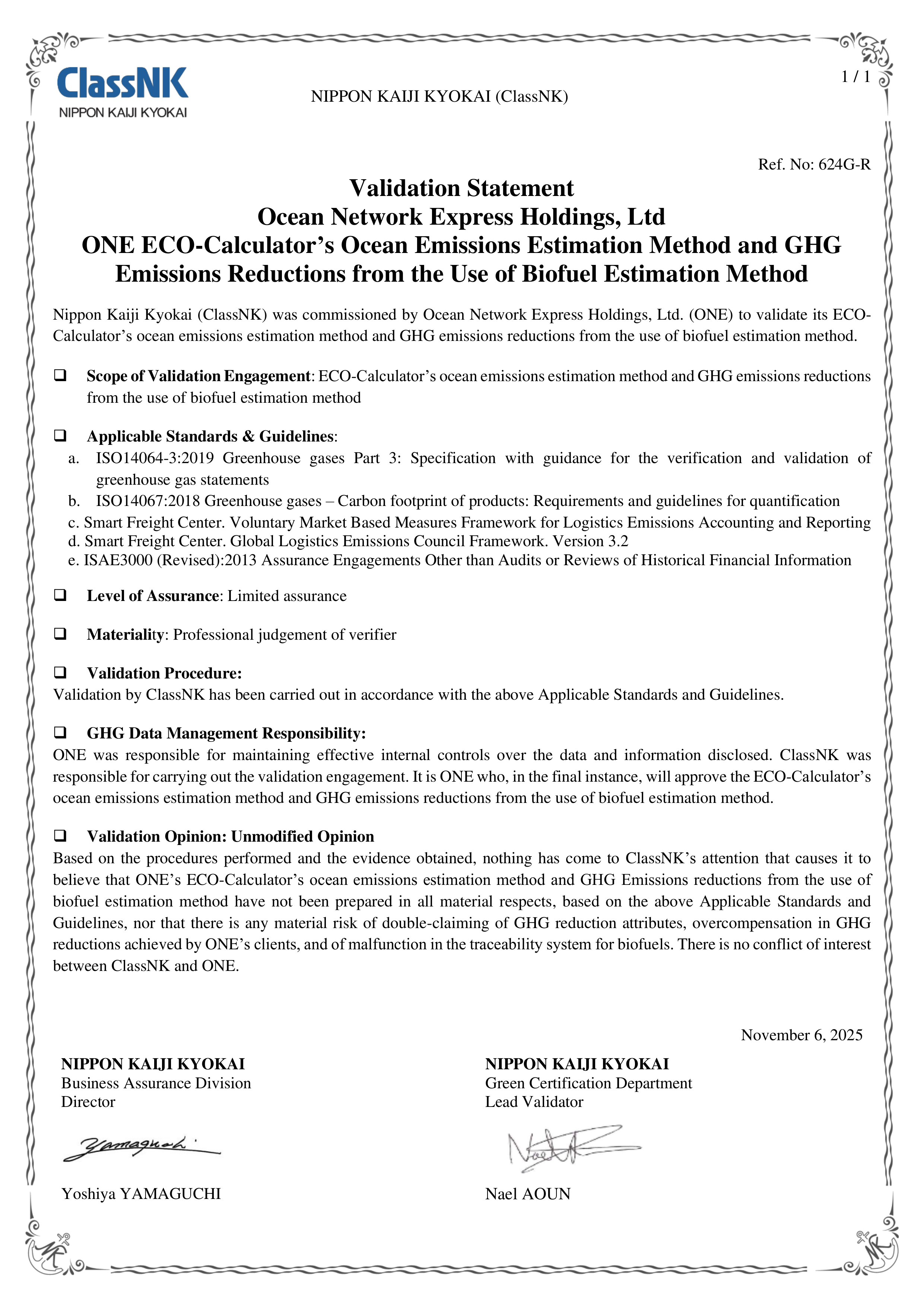
ONE Eco Calculator follows industry recognised methodology for their inland and ocean-going transportation. In addition, ONE’s ocean-going carbon emissions data are verified by ClassNK via the Clean Cargo methodology.
Inland
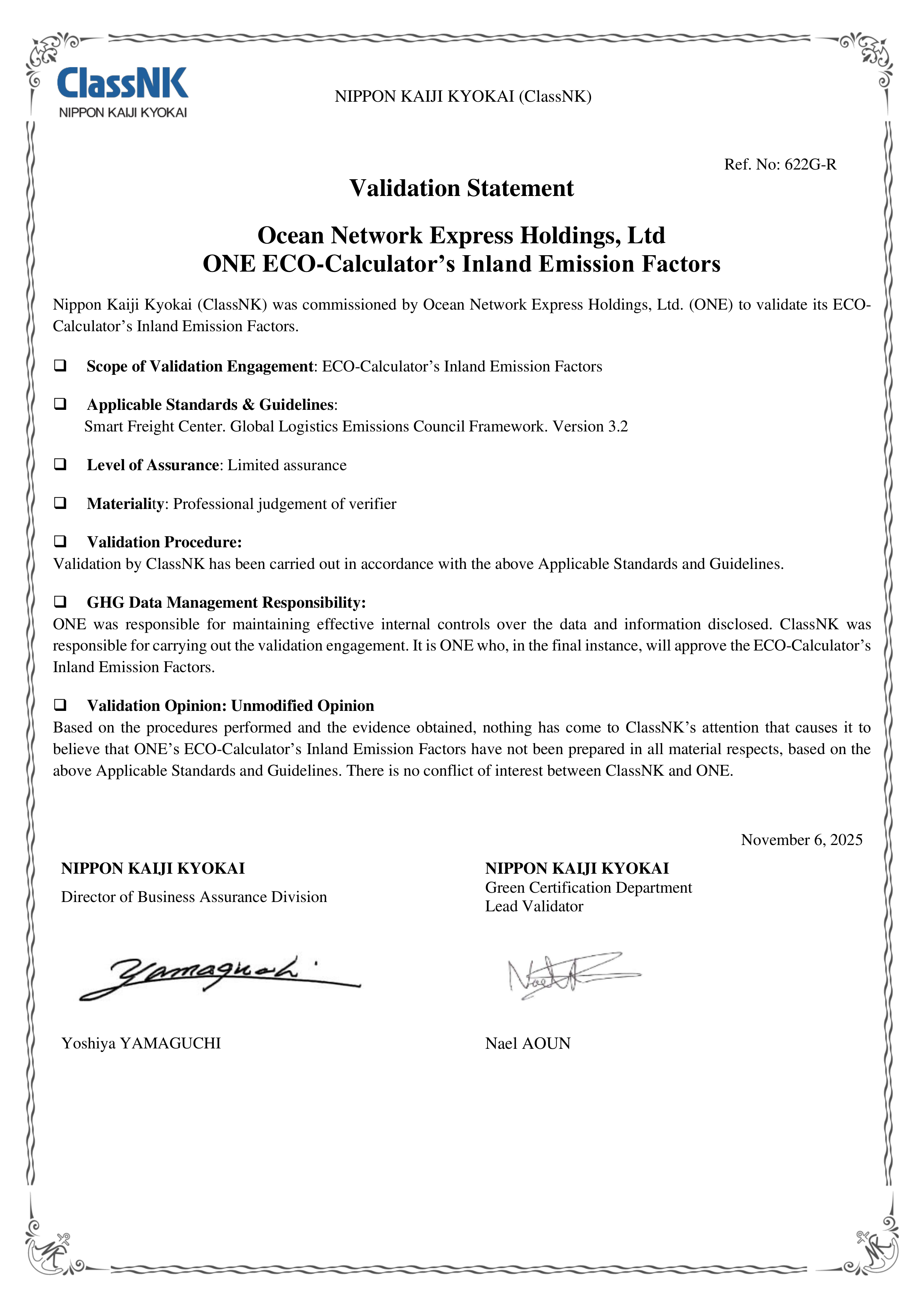
For our inland transportation, carbon dioxide emissions are calculated according to the GLEC Framework.
Ocean-going
For our ocean-going transportation, carbon dioxide emissions are calculated according to the methodology developed by the Clean Cargo. However, full utilization capacity is used for this calculation.
ONE ECO-Calculator’s Ocean Emissions Estimation Method and GHG Emissions Reductions from the Use of Biofuel Estimation Method
What is Insetting?
Carbon insetting is a carbon project that occurs within a company’s value chain or in local communities where their supplier operates.
An example would be the use of biofuels to reduce emissions. Biofuel produces lesser emissions than standard low sulfur fuel oil used onboard vessels. Emissions saved are later sold to customers indicating a direct emission reduction.
What is Offsetting?
Carbon offsetting refers to a reduction in GHG emissions by investing in projects outside of the company's value chain, and is in turn used to compensate for emissions that occur within the company's value chain.
Examples may include blue carbon projects, afforestation projects and renewable energy projects.
Difference between insetting and offsetting
| Metric | Insetting | Offsetting |
|---|---|---|
| Service | ONE LEAF+ | program in development |
| Impact on carbon footprint | Direct | Indirect |
| Emissions impacted | Within value chain | Outside value chain |
| Methodology based on | Compliance bodies | Voluntary bodies |
| Effectiveness | High | Variable |
| Environmental journey | Advanced | Beginning |
| Company carbon footprint | Large | Small |
| Resources available | Dedicated | Limited |
| Environmental commitments | Compliance | Limited |
| Use to address | Bulk of emissions | Residual emissions |